Photo Credit
 Online fever has everyone all atwitter. An article on Reuters highlights that Social networking sites are the "hottest attraction on the Internet", taking over the top spot long held by "porn". This is a MAJOR change in how people communicate. And, a welcome change in online users' "interests", too.
Research done by "data geek", Bill Tancer, analyzed the information of over 10 million web users, indicating that one of the major shifts in cyberspace has been a drop in the surfing of porn sites. Over the last ten years, porn searches have dropped from an all-time high of 20% of all web use.
"As social networking traffic has increased, visits to porn sites have decreased," said Tancer. Marketers take note of such an increase in social networking.
American celebra-mania is still affecting us, though, especially in the current U.S. presidential election. Web surfers are busy looking for photos of Republican VP candidate Sara Palin photoshopped in a teeny bikini or "researching" how tall is Barack Obama vice researching any real campaign issue.
Information spreads so quickly on the internet that the speed and the "need" for instant gratification predilects fact checking, too. The old adage of "just because you see something in print, it's not necessarily true" holds for online as well. Get the facts!
Now there's a business opportunity for someone: creating an online fact-filter search engine! And, I'm sure, those whose business models somehow combine porn and social networking are even happier with the survey results. They win either way.
So how popular are social networks worldwide? According to Synovate's survey, 42% of us are using social networks (like Facebook, MySpace, LinkedIn). The other 58% have no idea what we're talking about.
The survey was conducted over 13,000 internet users ranging from 18-65 years of age in 17 different global markets. Countries with the largest understanding of social networks? Holland 89%, Japan 71%, U.S. 70%.
Interesting factoid: on average only 26% of the users were actually using social networks. Holland 49%, United Arab Emirates 46%, Canada 44% and U.S. 40%.
Lots of people are uncomfortable giving their personal information online. Only 26% of all users surveyed , as a matter-of-fact. The highest fear rates: Serbians 71%, India 57%.
According to Synovate's Sr. VP, Bob Michaels, identity theft continues to be a major U.S. problem. Another growing issue is online defamation — posting negative and/or false information about someone online — so people are becoming more and more careful about the information they share. It's much easier to blast someone or something online if we only know you by your cleverly anonymous "handle".
So, who's most uncomfortable handing out their information? Japan and Germany both with 85%, Taiwan 83%, Canada 79%, Brazil and South Africa 77%, Poland and U.S. 70%.
And, then there are those people surveyed who think social networking is dangerous. Overall 51%. Brazilians 79%, U.S. 69% and Poland 62%.
Of interesting note, approximately 1/3rd of those surveyed claimed to be losing interest in social networking. Wonder who they are? No one I know.
Saturday, September 20, 2008
"Social Networking" has taken over porn's top spot

Thursday, March 02, 2006
International Bird Flu Summit in Washington DC, February 2006
 Companies offer wares to guard against spread of bird flu
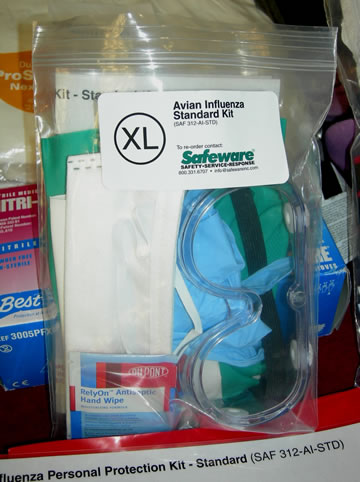
Friendship Industries has launched into PPE (Personal Protective Equipment) Kitting and is part of the global emergency prep for the Avian Influenza (aka Bird Flu or AI) Pandemic. Luckily, one of our small business partners and emergency equipment distributor, Safeware Inc., invited me to join them in exhibiting at the Bird Flu Summit. Click on the link above for an article published by Reuters based on an interview I did at the Summit, or read on for an excerpt: L to R: Me (in my "Intelligent + Medical" look), Safeware's Safety Expert-Chandler Martin, Safeware's President-Ed Simons, and DuPont's Global Industrial Segment Mgr-Andy Peralla
 27 Feb 2006 22:36:28 GMT
Source: Reuters
By Maggie Fox, Health and Science Correspondent
ALEXANDRIA, Virginia, Feb 27 (Reuters) - Worried that a courier might deliver avian flu along with that book you ordered to pass the time while you wait out the pandemic? Melissa Blankenship, director of sales and marketing for Friendship Industries Inc., has just the product for you. "You could easily wear these while using a keyboard," she said, demonstrating a thin, blue flexible glove. "And if the UPS (United Parcel Service) man comes, for instance, you can put this on for outside protection," she says, holding out a slightly thicker glove.
Companies are gearing up to help protect health care workers and the public in case of a bird flu pandemic, offering portable isolation units, packs with gloves, masks and suits and sanitizing systems. They demonstrated their wares on Monday at the Bird Flu Summit organized by meeting specialist New-Fields.
H5N1 avian influenza has moved steadily across Europe in recent weeks and into parts of Africa, after moving out of southeast Asia for the first time last year. It has killed or forced the slaughter of more than 200 million birds and is beginning to damage the poultry industry in some countries.
It does not yet easily infect people but it has sickened 173, by official World Health Organization count, and killed 93 of them. Experts fear it could change into a strain that easily passes from person to person, causing a pandemic. Public health specialists predict that, if it did, it could infect up to a third of the population in the space of a few weeks, wreck economies, force schools and businesses to close and overwhelm hospitals.
But simple hygiene measures and a little protective equipment could go a long way to guarding against infection, and distributors of these products report a steep rise in interest in recent weeks.
Blankenship said factories in southeast Asia are being re-fitted. "The companies that are making shirts for Wal-Mart, we need them to convert to making personal protective gear," Blankenship said. Her company is checking out potential factories in China, Malaysia, Indonesia and the Philippines.

 Posts