From Sheila Ann Manuel Coggins
These are some GREAT recommendations!
You know that feeling... the awful sensation that you just can't possibly blog about anything. Nothing inspires you enough. Everything seems too mundane. And, the more you think about blogging, the less you are inclined to blog. Indeed, if writers can get writers' block, then bloggers can get bloggers' block.
What do you do in moments like these?
1) Check your Inbox.
It's a great place to find fodder for blogging. Answer an email or two in your blog. React to a piece that you read from an email newsletter. Review a link or product that was recommended to you.
2) Start Blog Hopping.
We all do it on a regular basis - reading blogs from our blogroll. However, this time, read your favorite blogs with the purpose of finding ideas to write about. Also, try to follow links to weblogs you don't usually visit. Start asking questions like: "What are my fellow bloggers interested in at the moment?" or "What is the most popular topic that people blog about? Do I want to write about it too? Or perhaps, I can blog about something that is not too popular." Doing these things may spark something in your 'blocked' blogging brain.
3) Comment in Your Own Blog.
Yes, this idea is related to item #2. When you visit other weblogs, use your own blog when commenting on another blogger's entry that catches your attention. Or, if you post a short comment on someone else's blog, think of ways on how you can expand the idea.
Oh, and don't forget to use trackback, if your blogging system allows you to do so. (Although many blog software and/or hosts do not automatically support trackbacks, www.HaloScan.com offers a free tool.)
4) Read, Listen To, or Watch the News.
Even if your weblog is not about news, politics or current events, you will still benefit from finding out what's going on in the world. To give you a refreshed view, why not check out news sources that you don't usually refer to? For example, if you're a CNN person, check out BBC this time around. You might even want to try watching news in a foreign language.
5) Give Memes or Collaborations a Go.
Even if you're not too crazy about memes or collabs, you might still consider trying it out. Give it a different spin if you like. Say, instead of creating "100 Things About Me" - you can write "100 Things About My Company's Staff."
6) Create Lists.
This is an endless source of blogging ideas. Some possibilities: "Top 10" lists, "Favorites" lists, "Worst of the Bunch" lists, "Things To Do" lists, "Wish" lists, etc. These lists may be on any given topic such as movies, books, music, people, paintings, food, sports, and activities, among
many other things.
Here are the Ten Top 10 lists.
#1) Top 10 Favorites. You know this kind of list. Your favorite lists can be just about anything - books, movies, videos, music, actors/actresses, artists, writers, hobbies... You get the picture.
#2) Top 10 Dislikes / Peeves. Same thing as the 'favorites' list. Only on the nastier side.
#3) Top 10 Destinations. Or Top 10 Places To Avoid. These destinations/places can be anywhere in the world - even in your own neighborhood. Even if you're not writing a travel blog, these lists are always interesting reads.
#4) Top 10 Things About.... You, your pet, your crush, your interests... Whatever the topic, you can write Top 10 facts that you may wish to share with your readers.
#5) Top 10 Tips. Whether you're an 'expert' on knitting, surfing, or chess, you're bound to have some words of wisdom to share with your readers about your field/s of expertise/interest.
#6) Top 10 Ideas. This is another catch-all Top 10 idea with a twist. You can list anything here, but they should be categorized as "ideas." For example, you want to give ideas on how people can combat global warming. So, you can come up with "Top 10 Ideas on How To Fix The Problem with Global Warming". Or, something to that effect anyway.
#7) Top 10 Things That Excite / Sadden / Delight... You. Change the feelings, if you must. Other ideas that you may consider are: things that freighten you, things that anger you, things that make you fall in love, etc.
#8) Top 10 Things To Do. Or even Top 10 Things That You're Avoiding to Do.
#9) Top 10 Memories. Whether you're writing about the top 10 memories you have of your wedding day or that job interview you just had, listing things that you remember will help you preserve these moments.
#10) Top 10 Random Things. So, you're not in to organizing ideas and themes in a neat little package? Why not list random things that you just happen to think about? Just go for it!
7) Play Games, Answer Surveys, or Take Quizzes.
If you're not the sort of person who likes posting quiz or survey results as weblog entries, remember that you're not limited to the "usual route" of blog quiz-taking (i.e., find a quiz, respond to questions, and post the results as a blog entry). For example, after you take a quiz, you can write about particular items asked in the quiz. Or, you can write about other ideas you may have for a game, survey, or quiz for bloggers.
8) Blog at Random.
There are different ways you can blog at random. One way to do this is to pick up a dictionary or encyclopedia, open to a random page, and then write about a word, phrase or sentence that you find on that particular page. Another way is to flip through one of your photo albums (or boxes, if they're not in albums yet), and pick a random photo to write about - be it a memory, a fictional idea, or a non-fiction piece. You can also turn on the TV or the radio, then write about the first thing you watch or hear about. Another thing you might like to try is to find a journal writing software and/or book with creative writing prompts and pick a topic at random to write about.
9) Be a Sleuth!
Are there things that you've always wondered about but never found the opportunity to get the facts? You might have asked yourself one or more of the following questions at one time or another: "How do you build an igloo?" "What are the different species of spiders?" or "Who is the richest woman in the world?" Well, now might be a good time to get your detective or research skills in to action. Check search engines, almanacs, and other sources of information. Then, start blogging your findings!
10) Do Something New.
If not something new, any activity other than blogging or computer-related stuff will do. Sometimes, all you need is a little break. Go to the mall, watch a movie, go for a walk, visit the beach, or call a friend. Just get out there and live your life.
There are other ways to come up with blogging content other than the ones mentioned here. Go ahead and experiment! Just remember that living a full life is a surefire way to kick bloggers' block out of the picture.
In other words, live life, don't just blog about it!
Monday, May 29, 2006
10 Ways To Create Content For Your Weblog

Sunday, May 21, 2006
ASAE Marketing Idea Swap - Website Feedback
From: Jeff Hoffman
jhoffman@mail.infoinc.com
Hi everyone,
Twelve of us signed up to share feedback on each others' web sites.
So that everyone's site gets covered without a lot of work, I've
divided us up into 3 groups of 4 with the thinking that we share
comments within our group. Of course if you wish to review more
than the 3 sites in your group, feel free. I hope this system works
for you. See you at the next Idea Swap!
Best, Jeff
------------------------------------------------------------
Jeff Hoffman
Director, Association News Briefings
Information, Inc.
7700 Old Georgetown Road
Bethesda MD 20814
301-215-4633
I can't wait to hear these other Group's website
critiques as well!
-- Missy
Group 1
Dr. Coralee Van Egmond
Director of Professional Development
International Chiropractors Association
cvanegmond@chiropractic.org
http://www.chiropractic.org/
Anita Popwell
E-Commerce Director
Consumer Data Industry Association
apopwell@cdiaonline.org
http://www.cdiaonline.org/
Steve Doran
Director of Marketing
National Association of College & University Business Officers
SDoran@nacubo.org
http://www.nacubo.org/
Jeff Hoffman
Director, Association News Services
Information, Inc.
jhoffman@mail.infoinc.com
www.infoinc.com/assn-news
Group 2
Del Baker-Robertson
Marketing Manager
American Association of Museums
dbaker@aam-us.org
http://www.aam-us.org/
Kathleen Neeson
Marketing Coordinator
American Association of Homes & Services for the Aging
kneeson@aahsa.org
http://www.aahsa.org/
Ellen Kim
Creative Director
Graphek
ellenkim@graphek.com
http://www.graphek.com/
Dawn Rhine
Managing Director
Synergy Forces
drhine@synergyforces.com
http://www.synergyforces.com/
_____________________________________________
Ok, I've reviewed my assigned websites. Just let me say
in advance that I appreciate the opportunity to provide
feedback AND receive feedback. Please remember, every
criticism is given in a constructive vein.
Here is my 2 cents....
--Missy
Group 3
TO:
Reginald Beckham, Jr.
Marketing and Membership Manager
National Association of Housing Cooperatives
reginald@coophousing.org
The homepage is "busy"; I had to scroll down 3 times to view the
entire page. The calendar is not eye-appealing; borders are heavy;
lots of blank space, too. Logo is difficult to read; consider white text
over the photo versus black text. I love the pics on your top banner,
though; gave me a visual of what your association is.
Pages load easily, links open quickly and pics are not too large;
great for busy web users! Good use of video, although I would
suggest using a still clip from the video in addition to the text link
for more eye appeal. LH Sidebar format changes between pages
(some page sidebars seem to be wider than others); text align-
ments are "off" and sometimes hard to follow. Same thing with
pages; some are formatted to be much wider than others. There
are some alignment issues with text within a page, too. Ex: BOD,
Site Map and Member Association pages
Maybe you should check the site in several different browser
settings and on different desktop computers and laptops to assure
good format no matter who is looking at the site. Make sure your
site works well on a small format, too. The use of handheld browsers
is exploding; I know that I surf the web on my Treo all the time!
Some of your site, esp. your logo, is very hard to see in small format,
for instance.
IMPORTANT! Be sure all of your links, whether PDFs, DOCs or
other websites, open in a new browser window. One of your docs
locked up my IE, and one external link was one of those websites
that "steals" you; I couldn't get back to your site without going into
my history.
Perhaps consider easier navigation tools; add a "back" button on
every page; have a "HOME" link at the top of every page along with
your other main tabs (rather than at the bottom of every sidebar).
Every main tab page is very text heavy; consider dividing into sub-
tab pages and using just one important thing on the main tab page
with links to the sub-tab pages. Add photos to break up the text.
Some pages just seem to go on and on after the text/content ends...
check your HTML on those pages. Ex: BOD page
FAQ page: since answers are so text heavy, consider listing the
question only and providing a link to the answer; visitors may lose
interest before they read through to find their question.
No staff listing or bios; the web is an impersonal place and the only
way to personalize it is to put a human name and a human face on it;
same holds true with our organizations.
You really should have your copyright, current date (or at least the
current year) and contact info on the bottom of every page; do you
have a privacy notice? should have a link to that as well on every page.
I like your Glossary setup with the "back to top" link on every item.
Consider using that at the bottom of text heavy pages, too. Would be
great to have a
page visited.
Check your Search feature; it took me to a separate Google page with
lots of ads, etc. on it; visitors may get lost there.
Also consistent fonts are important on the web. Your font type and
size changes between pages; and sans serif is preferred for better
eye appeal.
You've got a lot of info to share on your site!
_____________________________________________
TO:
Amy Melrose
Client Services Specialist
Walton Thomas International
amy@waltonthomas.com
This was my favorite site of the three. Very eye-appealing, easy
to navigate, easy to read and understand. Pages load easily, links
open quickly and pics are not too large; great for busy web users!
There was a bit of wasted space on pages, esp. the homepage.
Homepage said "we-me/feature" rather than "you/benefit" to me
when reading it. Now I'm all for "white space" but it can be over-
used, too.
The top banner is very good. Good use of the logo. I also like your
tag line "Classic Service. Contemporary Vision" and would use it on
the bottom of every page! I like the fact that almost all of your
pages are one page, no scrolling! Good - no excellent!- graphics,
good font usage, too.
Great staff page! Faces!! I feel like I know your organization and
its people. But add an email link to each one and/or a phone num-
ber, whichever is your preferred contact method. I know, I know...
the old argument about spammers. Well, with the tech-savvy spiders
today, the only way you can avoid them is to NOT use your email
address or phone number anywhere on the web, not even filling out
online forms. But, then you run the risk of legitimate contact being
difficult. I'd rather deal with a little junk mail, then to miss a valid
business contact or opportunity. Use an alias email if you want;
good way to track where email contact is coming from, too. A visitor
shouldn't have to search for a way to contact someone. Need some
sort of contact info on every page, too.
Suggestion: instead of clumping testimonials on just one page, make
use of your blue "white space" in your RH sidebar and add a testi-
on each page. On the testi-only page, add a pic or graphic, whether
an organizational logo or, better yet, a pic of the work described!
Make the connection - Show the benefit! On the web, we read
graphics much more readily than loads of text. The graphics draw
our eye to the text.
Great GSA page; very informative, but again no contact info. Those
in the gov't definitely won't do much searching to find the appropriate
contact; you have to make it easy for them.
You really should have your copyright, date (and/or current year)
and contact info on the bottom of every page; do you have a privacy
notice? should have a link to that as well on every page. Make sure
visitors know your site is current.
Good use of links and they open in new browser windows! Great!
Great resume submission page!
Your site works well on a small format (handheld), too.
No search feature? No site map? Not sure if you really needed
either, though. Your info was succinct enough to navigate without.
Your site gave me just enough info to understand what you're all
about, but with the desire to learn more and the inclination to make
the call!
_______________________________________________
TO:
Jonathon Sper
Sales Executive
Election Services Corporation
jsper@electionservicescorp.com
I like the use of white text on blue background; very easy on the
eyes and easy to read. However, check consistency between pages;
the font type and size changes from page-to-page. Directions page:
font is much easier to read; I would use this throughout.
All pages, esp. the homepage, are too text heavy. Need some
graphics, pics and/or some color to break it up. Also, your main
tab links are a little too high on the page. I browse using a full-
screen browser and had trouble clicking on them. Good use of the
logo top banner on every page.
Good bottom of the page info on the homepage, but it needs to be
carried through on every page. Remember, you never know where
people will "land" when visiting your website. Be sure to update your
year to reflect the current year; this indicates that the website is up-
to-date; no one cares when it was started, just that the info is current.
Good use of links and they open in new browser windows! Great!
You have no issues with page widths; looks good!
Make sure your site works well on a small format, too. Your site is
almost totally illegible on my handheld. Looks like very tiny outlines
of white text on a white background.
On your "Markets Served" page, some on the list had no links. I
would have been interested to read about the markets listed that
had no further explanation like the live links did.
Contacts: could you list the address of both your SF, CA and DC
offices, too, in addition to your NY HQ?
Our Team: no contact info-email or phone. Add an email link to
each one and/or a phone number, whichever is your preferred
contact method. I know, I know...the old argument about
spammers. I'd rather deal with a little junk mail, then to miss
a valid business contact or opportunity. Use an alias email if you
want; good way to track where email contact is coming from, too.
A visitor shouldn't have to search for a way to contact you. Need
some sort of contact info on every page, too. (I think at least one
of your Team was blank, just a name.)
Competitive Advantage page: text heavy; consider using bullet
points instead of complete sentences and paragraphs.
Election Process: consider adding color to the flow chart.
No search feature? No site map? Would have been useful.
Suggestion: instead of clumping testimonials on just one page, make
use of your blue "white space" on your pages and add a testi on each
page. On the testi-only page, add a pic or graphic, better yet an
organizational logo! Make the connection - Show the benefit! Perhaps
logos would lend an identification factor/affiliation appeal with the
website visitor considering using your services.
Hope this helps and I look forward to hearing comments
on our website. If you can stand the abuse (LOL), I'd be
happy to re-visit any sites that have been altered for a
second pass. Hey, I look at marketing this way:
There is not right or wrong, only opportunities for
improvement.
Thanks!
Putting Friendship to Work for You,
Missy Blankenship, Director-Sales and Marketing
P.S. I'll be sure to pass along more critiques and
feel free to post your own here!
Friday, May 12, 2006
Putting the I in Your Team
I read about this very cool premise and book from Apryl Motley, CAE, who was the managing editor of ASAE's ASSOCIATIONS NOW, published in February 2006. Thanks, Apryl!
At your next staff meeting, ask all of the innovative people in the room to raise their hands. Chances are you'll be met with confused stares and perhaps a few cautiously half-raised hands. Most people associate innovation with the next big idea or some invention that will change the world as we know it. Get a grip!
"Innovation is not about discovering fire or reinventing the wheel," says Breakthrough Management Group CEO David SilversteinSilverstein. "It is a core competency that can be taught and measured within your association."

Silverstein is a co-author of Insourcing Innovation: How to Transform Business as Usual Into Business as Exceptional (Breakthrough Performance Press, 2005), which argues against the common practice of organizations looking externally rather than internally for innovative capabilities.
An organization's best innovators are usually in your staff, but they must be empowered to take risks and make their ideas known. Silverstein talks about the importance of organizations cultivating their ability to innovate from within.
He draws a clear distinction between creativity and innovation. In his blog http://www.leadershipandbusiness.com/, Silverstein writes the equation for innovation success as follows: "creativity + structure = innovation success.
Most organizations do not have an infinite amount of time to explore infinite ideas. There must be a process for sharing ideas in an organization. However, organizations that engage employees in brainstorming with no end-game in mind cause frustration for staff. There must be a process in place for ideas to be evaluated and put into action.
Silverstein recommends a convergent approach to idea generation. "It's important to take staff through the process of narrowing the universe of ideas and then converging on the best--perhaps the most economical or time-sensitive--ones," says Silverstein. Within this structure, staff is empowered to bring ideas to life.
One of the first steps toward insourcing innovation is to free staff of intellectual baggage--help make people feel comfortable taking risks. Silverstein emphasizes the importance of understanding that everyone in an organization has the potential to create. But creativity must be fostered among the entire staff. The job of leaders who want innovation in their organizations is to let people make mistakes and learn from them.
Silverstein suggests some additional strategies for leading an organization out of inertia and into innovation:
**Know when to step in and when to step back.
**Focus on one or two people. Make them your top idea generators or innovation athletes. They can help motivate the rest of the organization.
**Help people understand their own psychological inertia or 'comfort zone'. Become more aware of your own limitations. You'll be more conscious of them, and this will help you think more freely.
**Establish more frequent staff rotations. Move people around so they have fresh perspectives.
**Reward people who take risks.
What does the future look like for organizations that fail to innovate?
According to Silverstein, failure to innovate throughout your organization is "a formula for commoditization of whatever you do." Competitors will converge around the same ideas that you have. You must have a self-preservation motive: Grow or die.
Thursday, April 27, 2006
Marketing & Membership Symposium - You're Invited!
Join us for the 2006 Marketing & Membership Symposium, an exclusive learning and networking opportunity for association, marketing and membership professionals. This two-day conference is designed for experienced professionals looking to explore marketing, membership and sales topics with their colleagues. Stretch your thinking by examining new strategies and practical applications that will help market products and services, enhance member recruitment and retention and drive business success.
To be held Monday-Tuesday, June 26-27, 2006 at the Marriott Bethesda North Hotel & Conference Center. Nonmember attendance rate includes a one-year ASAE & The Center for Association Leadership membership.
The Why & How of Building a Great Staff Culture for Your Organization’s Success
Associations constantly search for new ways to increase passion and loyalty among their stakeholders. This interactive and engaging session explores the vital connection between passionate staff and stakeholders. The session will provide you a sustainable process for maximizing your staff's talents toward organizational success. The panelists will offer their experience, ideas, and examples of their programs to implement in your association. Learn how to harness your most valuable "human" resource's knowledge and experience and put it to work!
Our panel includes Yours Truly (yes, ME!) and....
Matt Baehr, PHR
Director of Membership
InfoComm International
703-273-7200 x 3080
mjbaehr@infocomm.org
Christopher D. Bailey
Director of Membership
http://www.acrnet.org/
the Alchemy of Soulful Work blog:
baileyworkplay.com/soulfulwork
chris@baileyworkplay.com
Phone 703-431-0948

Some great and very timely topics will be:
BUZZMARKETING: What’s Word of Mouth Have to Do with an IMC (Integrated Marketing Communication)?
LOST: Your Search and Rescue Guide to Membership Retention Loyalty Programs
MAVERICK MARKETING: How to Stand Out from the Herd, Get Better Results and Wrangle More Members Your Way
MARKETING & MAXIMIZING YOUR INVESTMENT: A Behavioral Systems Approach
How Sucessful is Your Organization’s Membership Eco-System?
ASAE & The Center for Association Leadership's Town Hall Meeting
GENERATIONAL DIFFERENCES: So What? Attracting and creating Value across Generations: What Works Today?
LEADERSHIP LAB: Giving Gen-X a Seat at the Table
STUDENTS: The Next Generation of Leaders
THE NEW MEMBER VALUE EQUATION: Creating and Delivering Value for Association Products and Services
TRACKING & EVALUATION MARKETING ROI: What Works?
THE "UN-SESSION": How to Invest in the Attention Economy
WORD OF MOUTH MARKETING: What it Means to You
Wednesday, April 19, 2006
The B-to-B Lead Drain and Truth-Based Selling
Most salespeople feel the point of qualification is to use time wisely. Here's what one sales coach suggests:

The message this coach delivers is that time is money. Your efficiency matters, and customers are infinite and undifferentiated, so if one doesn't fit, drop him or her quickly and find another more likely candidate. The implied message to customers is: My time is important, and you are not. You are important to me only in terms of how fast I can sell you and how many dollars I can get in the sale. I want to figure that out as quickly as possible to minimize my potentially unproductive time.
Consider applying this approach to some other aspect of human relationships. Suppose teachers looked at students this way? What's the reputation of those who consider dating solely a screening mechanism, rather than an exploration and learning opportunity? What would you think of parents who screened their interactions with their kids to determine what was in it for them?
The approach is built around a transactional, seller-centric model. You judge that you won't run into this person or this company again, so the only thing that needs to be done is to evaluate, as quickly as possible, whether or not you're going to profit from the contact.
It's the equivalent of a military "scorched-earth" policy. If there's nothing good for me, leave them behind. Pay them no mind, they're irrelevant. I'm busy and the monthly quota still needs filling.

Trust-based selling is different. Of course, if you're selling widgets, you don't want to be talking to potential buyers of window shades. But usually buyers and sellers get put together for some sensible reason. There may or may not be a sale coming out of it but some common interest brought them together.
These situations are not potential wastes of time — they're the best marketing opportunities you have. A lead you disqualified isn't just an empty hole where you invested some time. A disqualified lead is a human being you talked to or met or who sought you out — someone who has now formed an impression of you.
A lead you disqualified is a person who knows something about your business, who has enough of a relevant issue to believe you might be of help, who operates close enough to your customer base to warrant conversation. Such an individual is very likely to walk with or near the clientele that interests you. A positive impression can result in second- or third-level referrals. People put far more weight on personal testimonials than they do on unsupported images.
Never get rid of someone the minute you find out he or she's not qualified. Never leave unsolicited e-mail inquiries unanswered. Instead, invest some small amount of time to give those people the benefit of your knowledge and wisdom. Help point them toward solving their problem or issue. If your product or service isn't right for them, they don't expect you to continue to give charity. But they will be mightily impressed if you care enough to give a bit of your expertise to help them knowing it isn't going to result in a sale.
Isn't such an encounter a free opportunity for personalized publicity? Isn't it a chance to send someone into the market who understands your business and the clientele you seek, together with a testimonial that you behaved well toward the person — when you didn't have to?
Investing over time in those kinds of leads generates a reasonable rate of return. You can't tell which unqualified lead will result in a legitimate prospect, nor when; but if you live your selling life according to the principle of doing good when the opportunity presents itself, those leads will pay back several times the minor investment you made.
All that's required is to stop seeing leads as opportunities to be disqualified, and to consider them chances to help clients, with a payback stream less distinctly linked to clients than in qualified lead cases. The only difference lies in how fast you get paid and from whom.
This kind of thinking allows you to operate less from tactics and more from values. If you conduct business like this, you'll become known for it — in a positive way.
This is an excerpt from “Trust-Based Selling: Using Customer Focus and Collaboration to Build Long-Term Relationships” by consultant Charles H. Green. It will be published this month by McGraw-Hill. Available on Amazon.
Monday, April 10, 2006
Are Print Catalogs Extinct?
 The following is from an article by Kate Muldoon in DIRECT Magazine:
Excerpts from THOSE OF US IN CATALOG LAND SEEM TO BE IN A TIME WARP that causes us to think that print catalogs can look and work just like they always have. But we also don't hesitate to turn our sights to the future and predict that, with or without print catalogs, the Internet will be the road to sales galore.
Well…yes and no. It's true that electronic marketing can be a very good thing. Some catalogers report that, by far, most of their new customers come from constantly tested and refined search engine marketing programs. The downside is that often, customers acquired online don't spend as much. One possible reason is that we aren't adapting our print catalog strategies well enough so fresh customers can learn how and why they should keep buying.
Electronic marketing certainly seems to be the be-all and the end-all. In its 2005 Multichannel Retail Annual Trend Report, Abacus notes that Web site sales will surpass catalog purchases within the next 19 months. The Financial Times reports some analysts claiming that push e-mail has the potential to address a global market of 400 million users. With more and more companies such as Panera Bread, and cities like Orlando, FL and Philadelphia offering or planning to offer Wi-Fi for free Web access, the number of those able to go online will only grow.
Then there are the newer electronic sales avenues — bluecasting, for one — that have the potential for grabbing such audiences as commuters passing an area where video ads are beamed from billboards into their Bluetooth-enabled mobile phones. Sounds farfetched, but Direct Newsline reported in August that a firm in the United Kingdom pulled nearly 15% response using this sales method. As Apple has made available a video-ready iPod to its already 16 million-plus users, who knows if this won't be another way to reach new customers. And don't forget podcasting. It could be an interesting opportunity for catalogers with excellent editorial content on their Web site (like L.L. Bean) to create subscriptions for audio versions of that useful information.
All good reasons why it would not be insane to think print catalogs are indeed dead.
Nevertheless, here's why print catalogs should get stronger than ever:
Catalogs are free
A new mindset is dawning. Why pay if you can get it free? The Internet — which easily leads us to free audio and video downloads, podcasts, and information and services of all kinds — has helped convince Americans that getting things gratis is not only possible, but actually is becoming a requirement. Beyond the Web there are free newspapers, video (just set the timer to record what you like), product reviews, samples, etc. Catalogs, which can offer credible information on how to dress or decorate, what to give for gifts, solutions for the office and more, are like free magazines that provide a quick and simple way to obtain those very same items.
Consumerism is growing worldwide
An increase in advertising is one sign that a country is ready to buy more goods. Based on recent numbers in the Financial Times, agencies are betting that consumerism will grow in emerging countries. (“Worldwide [advertising] spending will rise to $406 billion this year from $386 billion last year.”) The countries being targeted are Brazil, Russia, India, China, Saudi Arabia and Indonesia. Many catalogers already have had some experience in Japan and Europe, and to some extent can use that knowledge to tap into new markets.
Granted, the ability to reach consumers in these areas naturally varies. Just two positive examples: (1) Brazil has had a thriving direct marketing business for years; (2) India's Department of Posts is attempting to meet customers' needs by considering adding e-post, by which consumers can access low-cost Internet service or have e-mail messages delivered to their door.
Catalogs make it easy to dream
The Internet is grand for finding something you want when you know what you want. But browsing by calling up electronic page after electronic page doesn't feel the same as comfortably sitting back and flipping the pages of a paper catalog and dreaming about what you might want in your life — and then having the choice of buying those things almost any way you like.
Catalogs are portable
OK, many new types of electronic communication are portable too. But really, what kind of detail can you see on those little screens? Yes, they'll get bigger, but never as big as those luscious printed catalogs you can pop in a bag, briefcase or pocket.
But we do have to rethink what our catalogs need to look like and offer. To encourage online customers to order more frequently, we may choose to adopt some of the strategies used by companies that mainly employ catalogs as traffic generators. Retailers have long known how to create and produce breathtaking catalogs whose main purpose is to drive you to their stores. As electronic marketing continues to grow, we should be seriously considering adding Internet-aimed, traffic-generating catalogs to our mix. As vendors often pay or offset the expenses for these traffic generators, there's little reason not to test the concept.
What does a traffic-generation catalog look like? More often than not it's printed on the glorious high-quality, high-weight paper you'd love to use but never have been able to afford. It has far fewer pages than a catalog and sometimes promotes a special event. Its intent is to create enough pleasure and excitement through mood-enhancing photography and tantalizing copy to get consumers to make the move to the Web or store — and buy!
KATIE MULDOON (kmuldoon@muldoonandbaer.com) is president of DM/catalog consulting firm Muldoon & Baer Inc. , Palm Beach Gardens, FL.
Katie Muldoon's book, Catalog Marketing, is considered the industry bible.
Monday, April 03, 2006
Welcome to Wikipedia

Welcome to Wikipedia, the free encyclopedia that anyone can edit. Wikipedia is among the Top 20 most-visited websites in the world. The website is run by a staff of only three people. So, obviously, the "volunteer" force that edits this most awesome of online encyclopedias is phenomenal, absolutely phenomenal.
Thinking of Wikipedia (and learning from the Wiki way), here's some food for thought about volunteers:
Make it easy for individuals to contribute.
Always welcome newcomers; they're the future.
Promote equality and a feeling of openness and inclusiveness.
Provide simple, minimal guidelines and policies.
Foster and support social interactions.
Support the community and the vision, not individual agendas and personalities.
Offer a meaningful purpose, meaningful relationships, meaningful contributions and a meaningful story.
Just my 2 cents for today! Enjoy!
Friendship Industries has even made it intoWikipedia!
Monday, March 27, 2006
Keep it Simple...writing suggestions for Marketing
Keep it Simple ... Similes, metaphors, and analogies
And what makes ideas simple? Similes, metaphors, and analogies.
Merriam-Webster Online Dictionary defines them this way:
simile: a figure of speech comparing two unlike things that is often introduced by like or as (as in cheeks like roses).
metaphor: a figure of speech in which a word or phrase literally denoting one kind of object or idea is used in place of another to suggest a likeness or analogy between them (as in drowning in money).

analogy: 1. inference that if two or more things agree with one another in some respects they will probably agree in others. 2. a resemblance in some particulars between things otherwise unlike.

Tuesday, March 21, 2006
Friendship Ambassadors Training Program

Friendship Industries’ Employees have the opportunity AND the responsibility to serve as our best ambassadors, community representatives and spokespersons. Our Employees are our most precious and largest investment – they are truly our Mission AND our Human Resources.
Friendship Ambassadors Training will serve as the first step in genuinely cultivating the necessary environment that is conducive for team-building, company growth, development, communication and stability. Click on the link for all of the modules.
All Staff and Employees should be well-versed in our Mission, our History, our Fund-raising efforts and needs, our Commercial capabilities and our Sales & Marketing strategies in order to convey the messages both inside and outside of Friendship. Friendship Employees are our best, most valuable asset and our best prospecting and networking resource.
Who is in a better position to help convey a positive message than our Employees? It is up to us to dispel the myths and reinforce the realities of Friendship’s quality, skills and abilities, not disabilities.
FRIENDSHIP AMBASSADORS PRESENTATIONS by MODULES
By each of the Three Departments that make up Friendship:
DEVELOPMENT ’s presentation would be mission-based and focus on the growth, expansion and fund-raising aspects of Friendship; in addition a “History of Friendship” presentation would focus on how and why there is a Friendship Industries
SALES & MARKETING ’s presentation would be commercially-based and focus on the marketable aspects of Friendship’s work; in addition the “Commercial Future of Friendship” would focus on what we see on Friendship’s horizons
HUMAN RESOURCES ’s presentation would be Rehab-based and focus on the competitive employment, extended employment and assessment aspects of Friendship, including supported employment outcomes; additionally the “Employment Future of Friendship” would focus on where we see the company progressing
“The greatest source of competitive advantage is not really COST or QUALITY, but CREATIVITY.”
While we have not yet started our own Idea Activation Program, I suggest the book Ideas Are Free ! I recommend it to everyone!
Thursday, March 09, 2006
Blogs I recommend...stay tuned for Updates!

According to the Pew Internet & American Life Project, blogs are hot. Two Pew surveys conducted in early 2005 showed that 16% of adults in the US (approx. 32 million people) are blog readers, a 58% increase from 2004. Most interesting is that 6% of US adults have created a blog. That's 11 million people, or about one out of every 17 Americans.
Church of the Customer
Duct Tape Marketing
Both have great podcasts, too!
Debbie Weil's Blog - WordBiz
Sunday, March 05, 2006
ASAE's Online Resources: Case Studies, Models and Samples, Whitepapers, Ideas and Recommendations
 I highly recommend these great resources:
http://www.centeronline.org/knowledge/
Welcome to the Knowledge Resource section. Here you'll find association case studies, models and samples, articles and whitepapers, book reviews, the Ten Cool Ideas collection and expert recommendations covering all aspects of association management. Additional resources are available onsite at the Results Direct Knowledge Center located at The Center for Association Leadership.
Thursday, March 02, 2006
International Bird Flu Summit in Washington DC, February 2006
 Companies offer wares to guard against spread of bird flu
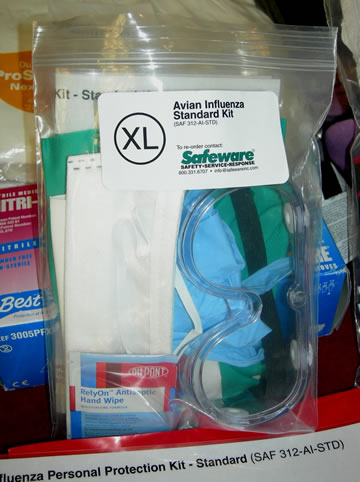
Friendship Industries has launched into PPE (Personal Protective Equipment) Kitting and is part of the global emergency prep for the Avian Influenza (aka Bird Flu or AI) Pandemic. Luckily, one of our small business partners and emergency equipment distributor, Safeware Inc., invited me to join them in exhibiting at the Bird Flu Summit. Click on the link above for an article published by Reuters based on an interview I did at the Summit, or read on for an excerpt: L to R: Me (in my "Intelligent + Medical" look), Safeware's Safety Expert-Chandler Martin, Safeware's President-Ed Simons, and DuPont's Global Industrial Segment Mgr-Andy Peralla
 27 Feb 2006 22:36:28 GMT
Source: Reuters
By Maggie Fox, Health and Science Correspondent
ALEXANDRIA, Virginia, Feb 27 (Reuters) - Worried that a courier might deliver avian flu along with that book you ordered to pass the time while you wait out the pandemic? Melissa Blankenship, director of sales and marketing for Friendship Industries Inc., has just the product for you. "You could easily wear these while using a keyboard," she said, demonstrating a thin, blue flexible glove. "And if the UPS (United Parcel Service) man comes, for instance, you can put this on for outside protection," she says, holding out a slightly thicker glove.
Companies are gearing up to help protect health care workers and the public in case of a bird flu pandemic, offering portable isolation units, packs with gloves, masks and suits and sanitizing systems. They demonstrated their wares on Monday at the Bird Flu Summit organized by meeting specialist New-Fields.
H5N1 avian influenza has moved steadily across Europe in recent weeks and into parts of Africa, after moving out of southeast Asia for the first time last year. It has killed or forced the slaughter of more than 200 million birds and is beginning to damage the poultry industry in some countries.
It does not yet easily infect people but it has sickened 173, by official World Health Organization count, and killed 93 of them. Experts fear it could change into a strain that easily passes from person to person, causing a pandemic. Public health specialists predict that, if it did, it could infect up to a third of the population in the space of a few weeks, wreck economies, force schools and businesses to close and overwhelm hospitals.
But simple hygiene measures and a little protective equipment could go a long way to guarding against infection, and distributors of these products report a steep rise in interest in recent weeks.
Blankenship said factories in southeast Asia are being re-fitted. "The companies that are making shirts for Wal-Mart, we need them to convert to making personal protective gear," Blankenship said. Her company is checking out potential factories in China, Malaysia, Indonesia and the Philippines.
Saturday, February 25, 2006
Philanthropy: Factors Influencing Charitable Contributions to Nonprofits
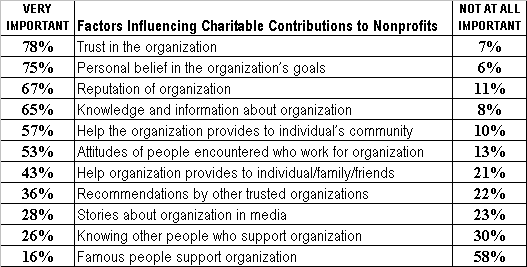
Source:
American Marketing Association, AMA Foundation, Yankelovich 2005 Surveys
P.S. If you have trouble reading this, I'm happy to email you the file.
Wednesday, February 22, 2006
Manufacturers are Putting More Emphasis on E-Business

A healthy majority (77%) of US manufacturing companies surveyed, believe that e-business (defined as web sites, email, online marketing, intranets and extranets) is “extremely” or “very” important to their company’s goals. And, 90% agreed or strongly agreed that e-business is “essential to the long-term success” of their companies.
When asked to identify their key e-business objectives, the response was:
to give information about the company (88%)
produce sales leads (70%)
bolster brand awareness (66%) and
complement customer service (55%).
The trend now seems to be to provide a more interactive web site experience rather than a static “brochure”.
Source www.btobonline.com


 Posts
Posts